


“I am very pleased to greet the people of the Canary Islands, whom I particularly admire.” This was the first statement made by Fidel Castro before a sea of microphones and cameras waiting for him on the steps of the Bahía del Duque hotel in southern Tenerife. “The Canarians are especially hardworking; they created the tobacco industry in Cuba, dedicated themselves to its cultivation, and are unsurpassed workers,” he emphasised. Dressed in his olive green military uniform and with a serene expression, he reinforced his argument with another compliment: “I congratulate you. We try to have Cubans imitate the customs of the Canarians, both as workers and as people.”
The leader of the Revolution, nearing 70 years old, had just arrived that Saturday afternoon, June 15, 1996, at Tenerife South Airport from Istanbul (Turkey), where he had participated a day earlier in a conference on human settlements in cities organised by the United Nations. He left a lingering question in the air: “What is the use of technological advancements and the global economy if they do not solve the problem of hunger, if the rich countries become richer and the poor become poorer?”
His 21-hour stay on the island took the government of José María Aznar by surprise. Initially, the government tried to avoid the stopover and later endeavoured to downplay the presence of the Cuban leader in the country. This occurred just days after the Spanish Prime Minister announced to US Vice President Al Gore the suspension of official aid to Cuba, following the approval three months earlier of the Helms-Burton Act, which intensified the Washington embargo on the island.
“I have nothing to ask the Aznar government. I have not thought about that for the moment; I wish them success in their task,” Castro replied quietly amid prolonged silences. He then looked towards Europe: “I see that many governments are struggling and there are many protests against the so-called austerity measures adopted to achieve the political objectives proposed within the community.”
Pressures from Madrid nearly jeopardised the press conference until the very last moment. It was ultimately held alongside a small roundabout, standing and outdoors. Furthermore, a mistake by a police officer diverted the official convoy through a construction site. Castro did not overlook this: “We entered through the building scaffolding and I wondered what the journalists would say, that we were avoiding seeing or greeting them. We asked about you; where are you? We must go to greet you; it is inexcusable.” He then lightened the mood with humour: “I have had a great workout climbing stairs; I needed it.”
Abel Matutes, the Minister of Foreign Affairs, contacted the Canarian president, Manuel Hermoso, that afternoon. He warned him, with evident annoyance, that the visit could generate a serious issue between the two countries. “He is our guest,” Hermoso replied, maintaining a cordial relationship with Castro following a visit to Havana.
While tensions were brewing behind the scenes, the Canarian government leader managed to emerge unscathed from the grilling imposed by his guest during a press conference, where Castro’s curiosity seemed boundless: “Don’t you have marble? Is there any volcano erupting? How much staff does a golf course employ in a day? What do Canarians call the mainland? (referring to the Peninsula) Is all that sea between the islands international waters? Is fishing here free for everyone? What treaty was that?”
With a measured tone, Fidel Castro also reflected, from a distance, on the situation in his country amid the continued tightening of the reins by his northern neighbour: “We have good capacity to resist and something more that we are discovering: to progress even under complicated conditions because we are becoming much more efficient. And perhaps someday we will thank those difficult conditions that made us utilise our nation’s resources better and advance despite the challenges.”
As night fell over southern Tenerife and the commander prepared to enter the hotel after the long press conference, a final question came: “Will you come for a holiday?” shouted a journalist. He turned around and replied cheekily: “Maybe, but when will they give me time? My neighbour gives me a lot of work.”
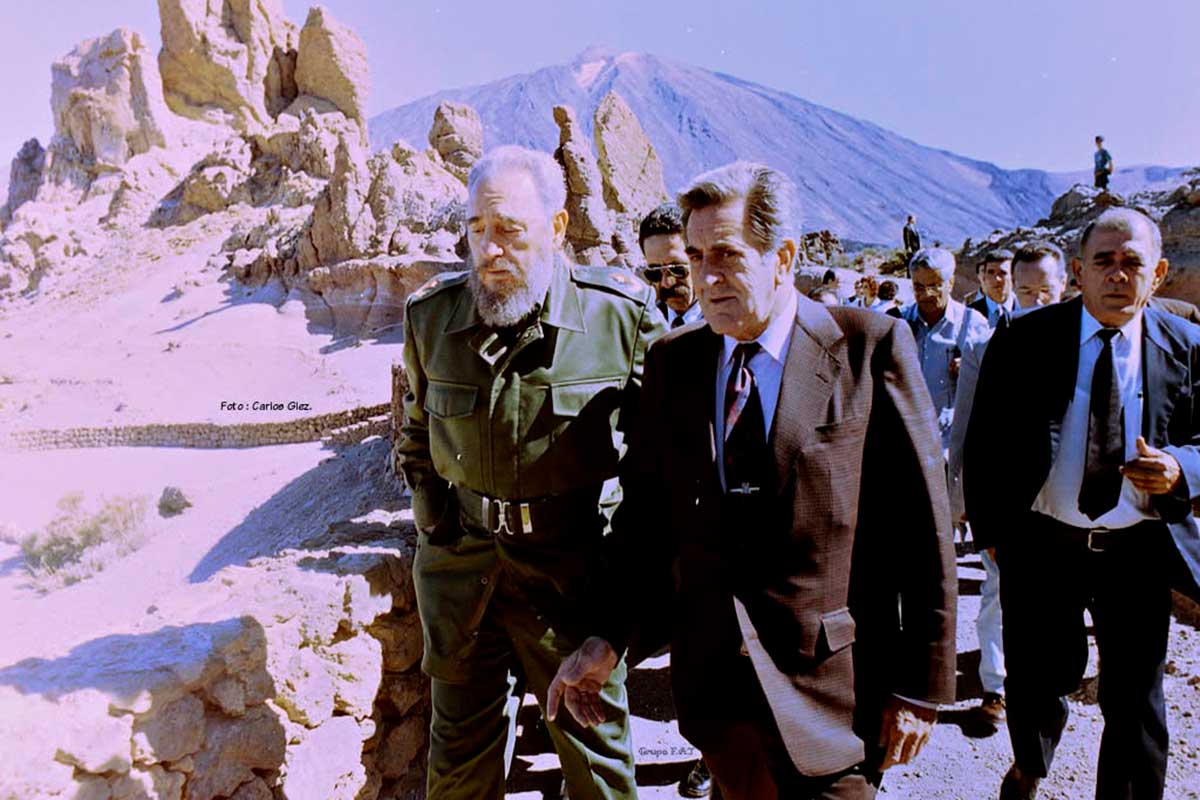
The next day, Castro visited El Teide. Next to the giant volcano, his doubts were aimed at biologist Antonio Machado, who meticulously addressed each of his questions and observations. “Bringing me to Teide was an excellent idea from my hosts. Unforgettable. I liked it very much. This place is incredibly well cared for. I can say I have never seen anything like it; there is nothing else like it,” he told journalist Carmelo Rivero, confessing that there he felt “like a descendant of the Guanches,” referring to his island heritage through his mother, Lina Ruz.
There, in Las Cañadas and alongside the iconic Roques de García, Lucas Fernández, now president of the Grupo Plató del Atlántico and editor of DIARIO DE AVISOS, showed Fidel Castro a thousand-peseta note featuring the same image before his eyes. “Keep it as a memento,” he said, to which Castro responded: “Are you the owner? Let’s take a photo together,” and a unique photograph was taken.
With the striking view of the Ucanca Valley in the background, the Cuban leader would make one of his most heartfelt statements: “I will leave a part of my soul floating among these volcanoes and I will cry when I leave because I am departing more Canarian to Cuba, although I do not know if I will return.”
His next stop was Vilaflor, where he had a humorous anecdote with its mayor, José Luis Fumero, who informed him that his municipality could give the Canary Islands their first saint, as would happen six years later with Pedro de San José de Betancur. The Cuban president listened with a glass of local wine in hand while reviewing a plate of white cheese. He quipped with his trademark response: “Does Brother Pedro need to perform a miracle to be canonised? Our arrival in Vilaflor is the miracle,” he joked.
On the way back to the hotel, the convoy stopped in Arona, where he greeted José Alayón Delgado, affectionately known as Joseíto, a supporter of his revolution and the father of the local councillor Juan José Cheché, who was also present. The visit ended with a tour of Los Cristianos and Playa de Las Américas. He reserved his final embrace before leaving the hotel for Francisco González Casanova, founder and president of the Canarian-Cuban José Martí association and promoter of the friendship group Leonor Pérez in Havana.
As a grand finale to the trip, Fidel Castro surprised everyone at the foot of the steps of his plane by taking a photograph with a dozen civil guards who had been part of his escort during his 21 hours in Tenerife. This unprecedented image capped off a high-voltage journey that would never be repeated.
In his final hours in Tenerife, the Cuban president granted a personal interview to journalist Natalia Cesteros, who published the exclusive in DIARIO DE AVISOS. In it, he revealed his admiration for José Martí and Simón Bolívar. When asked what he would eliminate from this world, he did not hesitate: “Imperialism.” He expressed regret for “not having been able to help my people and the world more” and acknowledged that what he felt most proud of was being a “Cuban revolutionary, internationalist, and having a mother with Canarian roots.”
When questioned about the qualities he valued most in a person, he mentioned two: “integrity and honesty.” After highlighting his love for reading and fishing, Castro joked with the journalist in his final question: “Is there anything you want that you have not achieved yet?” “A woman from here, from the Canary Islands,” he replied with a half-smile.