

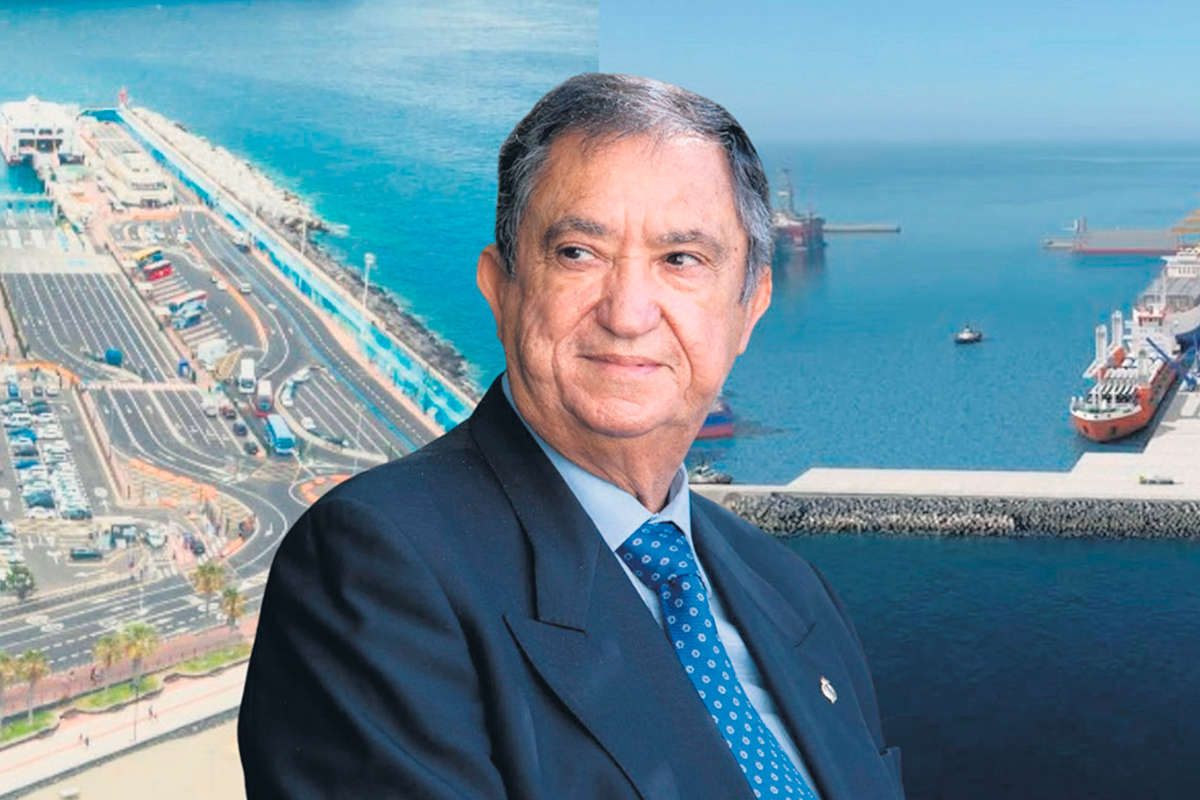

Pedro Anatael Meneses (1947), former senator for Tenerife, former director-general of the Merchant Navy and former president of the Port Authority of Santa Cruz de Tenerife, was one of the main opponents to the construction of the Port of Granadilla de Abona. Now, years after its opening, he asserts that the priority “should no longer be whether the port should have been built, but rather finding a way to turn it into a profitable facility that provides a return on the public money invested, both that already spent and what remains to be spent.”
Meneses’ stance comes at a time when the use of Granadilla as a solution to the congestion of the port of Los Cristianos is gaining political support. A resolution proposal raised to the Regional Committee of the PSC-PSOE on 7 February advocates enhancing the Granadilla dock as a “priority and strategic alternative” to alleviate the saturation in Arona.
“Initially, the Port of Granadilla was built against all odds,” recalls Meneses. He explains that his opposition was based on the operational problems the infrastructure could generate and the environmental impacts resulting from its construction. He also highlighted the type of traffic intended for the port, a large container terminal that would relocate operations from the port of Santa Cruz to the south; in his view, the winds would create “operational problems with the containers, hindering cranes from performing those manoeuvres.” Additionally, there was a proposal for a liquefied natural gas regasification facility.
The former president of the Port Authority states that the PSOE’s initial position was to expand the port of Santa Cruz via its northern dock, rather than constructing a new facility in Granadilla, but “politics being what it is,” he summarises.
The battle even reached the European Parliament. Meneses recalls defending his opposition to the port before the European Petitions Committee, representing the platform he had created against the project. He argued against the port, citing, among other reasons, its impact on the seagrass meadows in the area. The solution came through legislative modification that allowed the project to go ahead.
“It is a port that currently has no activity, but we must find some,” he states. Among the options he suggests is ship repair, which could be complemented by the construction of a shipyard. Meneses notes that “there is land awaiting development” and that discussions about implementing this industry in the area have been ongoing for decades. The third area of his proposal focuses on energy transition. He advocates for reserving spaces for the supply of new non-polluting fuels for maritime transport, such as liquefied natural gas, ammonia, or biofuels.
The most significant measure, in his view, would be declaring Granadilla a free zone. This would grant ships docking there customs and tax advantages, facilitating the transit and storage of goods. “It is a technical matter; politics needs to make decisions and move beyond cronyism,” he asserts.
The second major aspect of his proposal centres around the port of Los Cristianos. He believes that this infrastructure has been in a “critical situation for years” due to the constant growth of maritime traffic with La Gomera, El Hierro, and La Palma, a pressure that is daily transferred to the southern road network.
“We warned about the collapse of Los Cristianos 30 years ago,” he maintains. His proposal is clear: “The port should be reserved for sports and fishing activities, and cargo, as well as a significant part of the passenger traffic destined for the Green Islands, should be moved to the dock of the industrial estate.”
Among the actions that could improve land mobility, he mentions a proposed tunnel connecting the port with Avenida Chayofita, traversing the mountain. This infrastructure is valued at approximately 600 million euros, which he dismisses emphatically as “nonsense.”
Costs for Shipping Companies
One common argument against relocating maritime traffic to Granadilla is the increase in operating costs for shipping companies. Meneses acknowledges that journeys would be “slightly longer, about 20-25% more of the total journey,” but he believes the analysis should be done comprehensively. “The distance is greater, around fifteen minutes longer from La Gomera, for example, but the origins and demand for goods and passengers come from 70% Santa Cruz and the north,” he explains.
The long-standing spectre that has accompanied Granadilla since its inception is strong winds, which he dispels: “it does not affect the operations of the vessels engaged in these activities.” At the same time, he calls on the Port Authority to “conduct empirical tests to definitively dismiss that argument.”