

The Arguineguín Fishing Port: A Symbol of Institutional Inaction
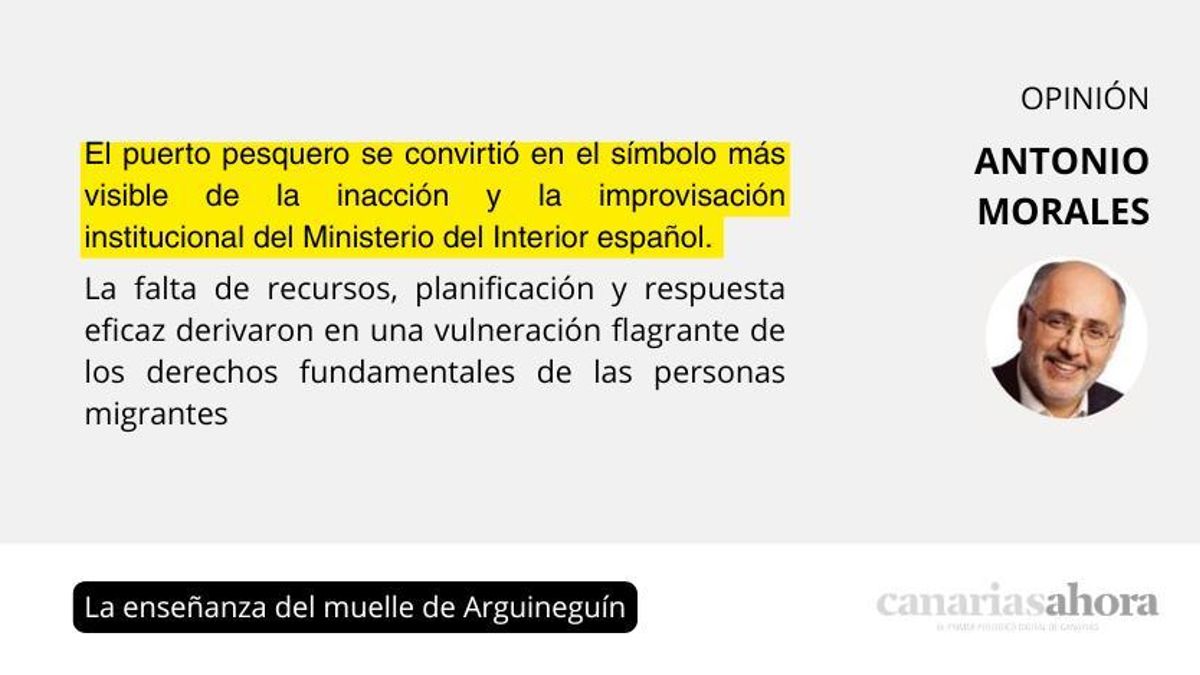
The Arguineguín fishing port became the most visible symbol of institutional inaction and improvisation by the Spanish Ministry of the Interior. A lack of resources, planning, and effective response led to a flagrant violation of the fundamental rights of migrants.
2020 Migration Crisis
Between August and November 2020, Gran Canaria experienced a severe migration crisis. In response to the increased number of arrivals via the Canary route, the Spanish Government set up an improvised camp at the Arguineguín dock, which eventually housed up to 2,600 individuals in appalling overcrowded conditions. Numerous institutions and humanitarian organisations called for the immediate closure of what was labelled the “dock of shame.”
Images from the port, which circulated globally, highlighted the absence of an appropriate strategy and a lack of respect for the dignity of those seeking protection and a better future.
Pope Leon XIV’s Visit
During his visit to Gran Canaria last Thursday, Pope Leon XIV approached this fishing dock – “a global symbol of the Atlantic route” – to remember those who lost their lives during the crossing, denounce the treatment of migrants, and acknowledge the efforts of organisations, volunteers, and institutions that assist them. He sought to turn the place into a symbol of welcome, integration, and hope.
While on the island, Pope Leon XIV emphasised the need for humanity to embrace peace, protect migrants, question European migration policies, and defend human dignity, human rights, and social justice. This historic moment should prompt us to reflect deeply on these issues in such turbulent times.
International Tensions and Challenges
We are living in an era marked by profound international tensions, an upsurge in hate speech, and increasing political and social polarisation, which threatens to erode the democratic foundations built over decades. Wars, forced displacements, economic inequalities, and environmental degradation create uncertainty and fear among large segments of the population. In this tumultuous context, territories like the Canary Islands take on a unique symbolic and political significance as spaces of coexistence, diversity, and cultural exchange.
The history of the Canary archipelago has always been linked to human exchange. Its geographical position in the middle of the Atlantic, between continents, has made the islands a place of passage, welcome, and cultural mestissage. Europe, Africa, and America converge in the Canaries, not only geographically but also through a human reality that has shaped island identity over the centuries. This mix of influences constitutes one of the archipelago’s primary social and cultural heritages today.
Embracing Diversity
Diversity should not be viewed as a threat but rather as a collective opportunity. However, in many places, political positions are emerging that turn difference into a reason for confrontation. Prejudices against those who hold different beliefs, practice different religions, or come from other countries are being fuelled, while simplifications of social complexities based on fear and exclusion grow.
In the face of these challenges, it is essential to advocate for a democratic culture grounded in mutual respect, pluralism, and dialogue. Democracy is not merely about voting; it requires coexistence based on ethical and social principles that acknowledge the dignity of every person. Without pluralism, there is no full democracy.
Building Cohesion
Democratic coexistence demands the strengthening of spaces for encounter. The most cohesive societies are those capable of engaging in dialogue from their differences without turning them into irreconcilable trenches. Respect for cultural, religious, and social diversity involves building common values based on the recognition of others and an active commitment to human rights.
In the Canary Islands, this reality holds particular significance. The archipelago has been affected by immigration, poverty, and external dependence. Thousands of Canarians had to leave their homeland in search of opportunities, a memory that should enhance empathy towards those arriving today, fleeing war, hunger, or despair. Migrations are part of humanity’s history and should be addressed through cooperation and respect for human dignity.
Global Challenges and Sustainable Development
The islands are also in a sensitive position concerning major global challenges. The climate crisis, resource scarcity, and energy dependence necessitate a reconsideration of development models. Sustainability cannot be separated from social justice or collective wellbeing. Therefore, it is crucial to move towards economic models that prioritise environmental sustainability, energy sovereignty, and territorial balance. Progress must place people and territory at the centre of political decisions.
Numerous consequences arise from ultra-peripherality and a development model that, despite economic and tourism growth, has not managed to guarantee the wellbeing of a significant portion of the population. The archipelago maintains some of the highest rates of poverty and social exclusion in the state, while inequality deepens and access to decent housing becomes an increasingly serious problem for thousands of families. This reality is often irresponsibly exploited by certain political groups – both far-right and some self-proclaimed progressives – to target vulnerable communities and fuel xenophobia.
Defending Democracy and Equality
The defence of democracy and its values also entails combating inequalities. Where exclusion and precarity exist, collective trust weakens. Public policies must guarantee basic rights such as housing, education, healthcare, and decent employment.
In this context, culture is an essential tool for constructing critical and cohesive citizenship. Through education and cultural exchange, values such as empathy, coexistence, and democratic thought are reinforced. Societies that promote dialogue are less vulnerable to extremism.
Spiritual and religious traditions can also contribute to building bridges of understanding when positioned in the service of human dignity, justice, and peace. Democratic coexistence requires acknowledging freedom of conscience and the right of each person to live according to their values while respecting common rights.
Canary Islands as a Model of Coexistence
The Canary Islands have unique conditions to become a benchmark for Atlantic coexistence. Their multicultural reality and strategic position place them in a privileged position to foster a vision based on cooperation among peoples and cultures. This vocation for encounter should be part of a project committed to peace, sustainability, and social justice.
However, defending these values requires civic courage. It is necessary to actively combat xenophobic, racist, or authoritarian discourses that attempt to normalise exclusion. Democracy needs citizens committed to human rights and the construction of inclusive societies.
The Importance of Solidarity
In times of global uncertainty, it is more crucial than ever to recover the value of coexistence. In the face of those who seek to divide through fear, it is imperative to advocate for solidarity, dialogue, and cooperation to meet the challenges of today and tomorrow. The Canary Islands can and should remain an open space to the world, where diversity is a source of collective richness.
Peace is not merely the absence of war. It is built by ensuring dignity, equality, and opportunities for everyone; by defending democracy against authoritarianism, strengthening public services, and protecting the environment. In a time characterised by confrontation and unease, betting on coexistence and pluralism becomes an essential condition for building a more just and humane future.
The visit and message of Pope Leon XIV should also serve as a basis for reflection on coexistence, diversity, and democracy in times of uncertainty.